EN
EN

When planning a glamping site, resort or tourism accommodation project, developers often compare traditional cabins with prefabricated modular cabins such as Apple Cabins. Both can provide attractive accommodation, but the construction process, transportation, customization and site requirements can be very different. A traditional cabin is normally constructed largely on site, while a factory-produced Apple Cabin can move a significant part of the manufacturing process into a controlled production environment before being delivered to the destination.
The right choice depends on the project rather than a simple question of which building type is better. A developer may value the architectural appearance and guest experience of a traditional cabin, while another may place more emphasis on factory production, repeatable quality and simplified site construction. OCM House provides Apple Cabin solutions designed for international applications, allowing developers to combine modular manufacturing with customized accommodation concepts.
The design of a resort cabin directly affects the guest experience. Visitors may be attracted by the architecture, views, natural light, privacy and connection with the surrounding landscape before they even enter the room. Apple Cabins can be developed around this principle, with the external structure and internal layout treated as part of the overall accommodation concept.
A traditional cabin can also offer strong architectural character, especially when it is individually designed for a particular site. However, conventional on-site construction can require more coordination between local trades, materials and contractors. Changes to the design may also affect the construction schedule and cost.
A factory-produced Apple Cabin can standardize the structural and manufacturing process while still allowing customization of windows, exterior finishes, room layouts and interior materials. For a resort developer planning multiple units, this can provide a balance between a consistent visual identity and the ability to create different cabin categories.
The key difference is where the building work happens. Traditional cabins normally involve more construction directly at the project site. This means the project may need local carpenters, electricians, plumbers, roofers, interior contractors and other trades to work together over an extended period.
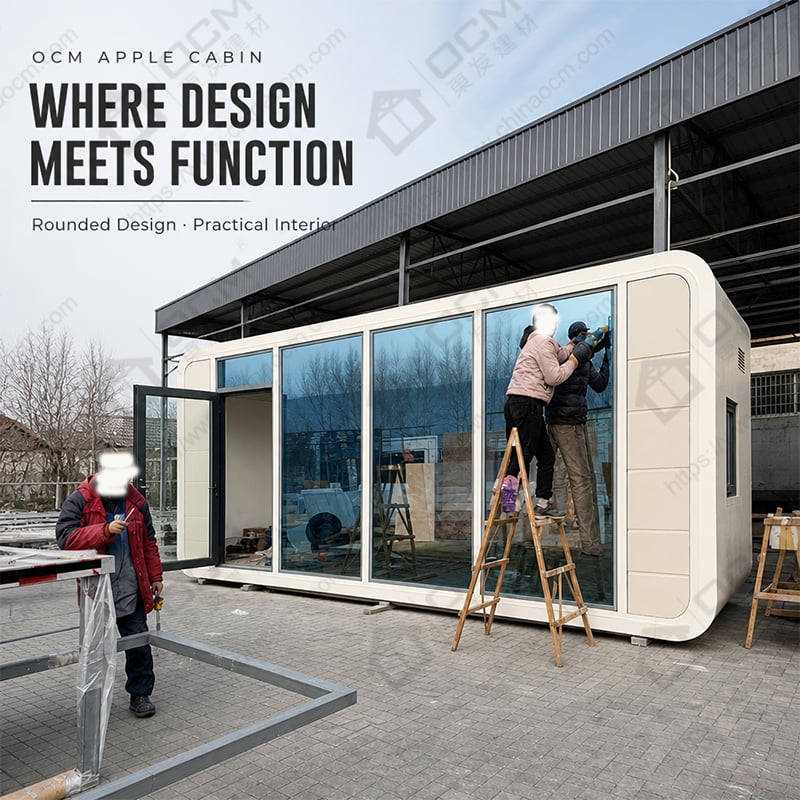
A prefab Apple Cabin moves a larger percentage of this work into the factory. Structural components, wall systems, windows, doors, internal finishes and selected utility components can be prepared before shipment. This does not eliminate site work, because foundations, delivery, positioning, utilities and final installation still need to be completed, but it can reduce the amount of construction that takes place at the resort itself.
Factory production can also support greater consistency between units. When a resort needs ten, twenty or fifty cabins, repeating an approved design can help create a more standardized development. This can be valuable for operators who want predictable room layouts, materials and maintenance requirements.
It is difficult to say that an Apple Cabin is always cheaper or more expensive than a traditional cabin because the cost structure is different. A traditional cabin may use local materials and labor but require more site work and project management. An Apple Cabin may have a higher factory specification but benefit from controlled production and reduced on-site fabrication.
The right comparison is therefore based on the complete project scope. Buyers should compare structural materials, insulation, windows, roofing, flooring, bathroom, kitchen, electrical, plumbing, furniture, transportation, foundation and installation.
International shipping should also be included in the comparison. An Apple Cabin manufactured in China may require ocean freight and inland transport, while a locally built cabin may require more local labor and material handling. A remote resort site can further increase conventional construction costs because workers and materials need to be transported to a difficult location.
For this reason, project owners should calculate the total installed cost rather than comparing only the factory price or local construction quote.
An important advantage of modular construction is that the building can be prepared for transportation before it reaches the site. However, the logistics need to be planned carefully.
The developer should confirm packed dimensions, weight, shipping arrangement, destination port, road access and final lifting requirements. A beautiful cabin can still create logistical problems if the delivery route is too narrow or if there is insufficient space for lifting equipment.
Foundation planning is another important factor. Traditional cabins may be built directly on foundations constructed specifically for local conditions. A factory-produced Apple Cabin also needs a suitable support system, but the foundation can be coordinated with the exact dimensions and support points of the modular building.
For resort projects in mountains, forests, coastlines or other challenging environments, the foundation, drainage and access should be evaluated before ordering. This helps avoid delays when the building arrives.
Customization is one of the areas where a factory-produced Apple Cabin can be particularly useful. A resort operator may want a standard cabin for couples, a larger cabin for families and a premium version with enhanced interior finishes. The same manufacturing platform can potentially support several configurations.
Customization can include room layout, windows, doors, flooring, wall finish, bathroom, kitchen, lighting, furniture, insulation and other building components. The exterior design can also be coordinated with the overall project concept.
Long-term maintenance should also be considered. When multiple cabins use standardized components, replacing a damaged door, window or interior component may be simpler than maintaining completely different building systems across the resort. A standardized design can therefore help with operational efficiency as well as initial construction.
1. Is an Apple Cabin cheaper than a traditional cabin?
There is no universal answer. The comparison should include factory construction, materials, labor, shipping, foundation, utilities and installation.
2. Can an Apple Cabin be customized for a resort brand?
Yes. Depending on the model, exterior and interior finishes, layouts, windows, doors and other details can be customized.
3. Is an Apple Cabin suitable for remote resort sites?
It can be, but transportation, road access, lifting, foundation and local utilities should be evaluated before production.
Traditional cabins and Apple Cabins can both work for resorts, but they follow different construction and project-management models. Traditional construction provides broad local flexibility, while factory-produced Apple Cabins can provide repeatable manufacturing, controlled production and efficient customization for multi-unit projects.
For developers planning glamping resorts, tourism accommodation or modular hospitality projects, the decision should be based on total project cost, site conditions, guest experience, installation, logistics and long-term operation. OCM House can develop Apple Cabin solutions around your project location, required room configuration and number of units.